


Here's a question I've been asking marketing leaders lately: how many AI tools is your team running? Most say four or five. Some say ten or more. Then I ask a follow-up: do any of them know what the others know?
The answer is always the same. No. Not even close.
They Don't Know Each Other
Think about your actual AI setup for a minute. You've got one tool for writing. Another for research. Maybe something for social, something for email, something your engineering team put together for internal use. Each one was configured separately. Each one got its own prompt, its own instructions, its own version of your brand voice, your ICP, your messaging hierarchy.
The agent drafting your LinkedIn posts has never talked to the one writing your email nurture sequences. The tool your team uses for competitive research has no idea what your current GTM narrative is. The internal agent someone built for sales enablement is working off a brand brief from eight months ago.
They're all running in parallel. Disconnected. Each operating with whatever context it happened to receive when someone first set it up.
That's the starting condition for most teams right now.
You Become the Context Layer
In practice, your team fills the gap. You copy-paste context from one system to another. You maintain separate prompt libraries for different tools. You re-explain your brand voice every time someone spins up a new agent for a new workflow. Someone creates a Google Doc called 'AI Prompt Guidance' and eventually it gets stale and nobody updates it.
The coordination overhead is real, but it's easy to miss because it's spread out. It's not one big visible failure. It's five minutes here, fifteen minutes there, a back-and-forth about why the AI output "doesn't sound like us" that happens every week or two.
You never fully trust that each tool is working with the current version of who you are and what you're trying to say. So you over-prompt. You double-check. You edit everything before it goes out.
At its core, this is a coordination problem. It just doesn't look like one, because it's hiding inside your normal workflow.
The Context Silo Problem
I've started calling this the context silo problem.
Your marketing knowledge, your brand voice, your ICP, your competitive positioning, your messaging frameworks, your product narrative, all of it exists as institutional knowledge inside your team. But in practice, that knowledge is fragmented across every AI tool you run. Each tool holds a slightly different piece of it. None of them have the whole picture.
This isn't a problem with any individual AI tool. The tools themselves can be excellent. The problem is architectural. There's no shared memory layer. There's no single source of truth that all your agents draw from.
Every agent, however capable it is on its own, is making decisions based on an incomplete picture of your brand. And that gap between "what the agent thinks you are" and "what you actually are" is where quality problems live.
Brand Drift
The downstream effect of context silos is something I've started calling brand drift.
Not dramatic failures. Not obviously wrong content. Just a slow, steady divergence between what your brand actually is and what your AI tools think it is. The agent writing your LinkedIn posts has a slightly different sense of your tone than the one drafting your email sequences. The tool summarizing your sales calls has a vague picture of your ICP that doesn't quite match your positioning doc. The internal agent your dev team built for proposal writing is still using the messaging from two product iterations ago.
Over time, the outputs drift. And the drift is subtle enough that nobody catches it until you put everything side by side and realize nothing sounds like it came from the same company.
At small scale, this is annoying but manageable. At scale, it's a real brand problem. And scale is exactly where things are heading.
Why This Gets Worse, Not Better
Here's what makes this more urgent: the number of AI agents your team runs is going to grow, not shrink.
We're moving from a world of "one AI tool that does everything" to "many specialized agents that each handle a slice of the work." That's probably the right architecture. Specialized agents can be dramatically better at specific tasks than a generalist one. The models themselves are improving fast, and the tooling to build custom agents is getting easier by the month.
But if the underlying problem is that agents don't share context, then more agents means more fragmentation. More copies of your brand floating around in different systems, each drifting a little further from the source. More coordination overhead. More time spent being the human glue between tools that should be talking to each other.
The teams that figure this out now will have a real structural advantage. The ones that don't will spend the next two years managing brand chaos at an ever-increasing scale.
What a Real Solution Looks Like
If you think about what you actually need, it's not that complicated to describe.
One place where your brand, your ICP, and your marketing strategy live. Not in a Google Doc that lives in someone's Drive folder. Not in a system prompt that gets copy-pasted around and then forgotten. A real, accessible endpoint. Something any agent can call before it generates anything.
It needs read access: an agent pulls the context it needs before it starts working. It also needs write access: when your positioning evolves, the knowledge gets updated in one place and every agent benefits immediately. And it can't be locked to any single AI vendor. Whatever you're building with, whatever tools your team is running, they all need to be able to reach it.
The concept is simple. What's been missing is the actual infrastructure. A shared memory layer for your AI stack, purpose-built for marketing context. Nobody had built it yet.
The Payoff
This is what we built the Quotient Memory API to do.
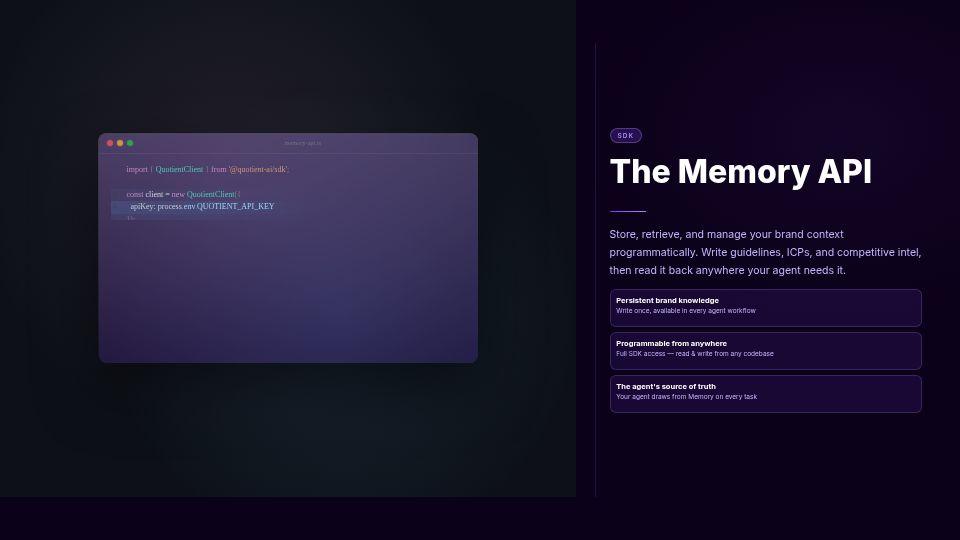
Your brand voice, your ICPs, your competitive intel, your messaging hierarchy: it all lives in Quotient's Memory already if you use the platform. The Memory API makes that context programmable. Generate a scoped developer key, hand it to any agent you run, and that agent now draws from the same source of truth your marketing team already lives in.
The custom Claude integration your team built for blog drafts? It knows your voice. The internal agent your engineers are using for proposal writing? It knows your ICP. The social tool someone is experimenting with? Same memory. One authoritative source, accessible everywhere, always current.
This is the shift from a collection of isolated AI tools to an actual AI stack. And it changes what "on-brand" means at scale. It's not a property of a single tool anymore. It's a property of your infrastructure.
I don't think most teams have fully absorbed how important this is yet. They will. Because the problem only grows from here, and the teams that solve the context layer now are the ones that are going to look like they have a serious operational advantage two years from now.
The context silo problem is solvable. You just need a place for the memory to actually live.
Blog
Keep up with the latest
from Quotient
Similar Topics