


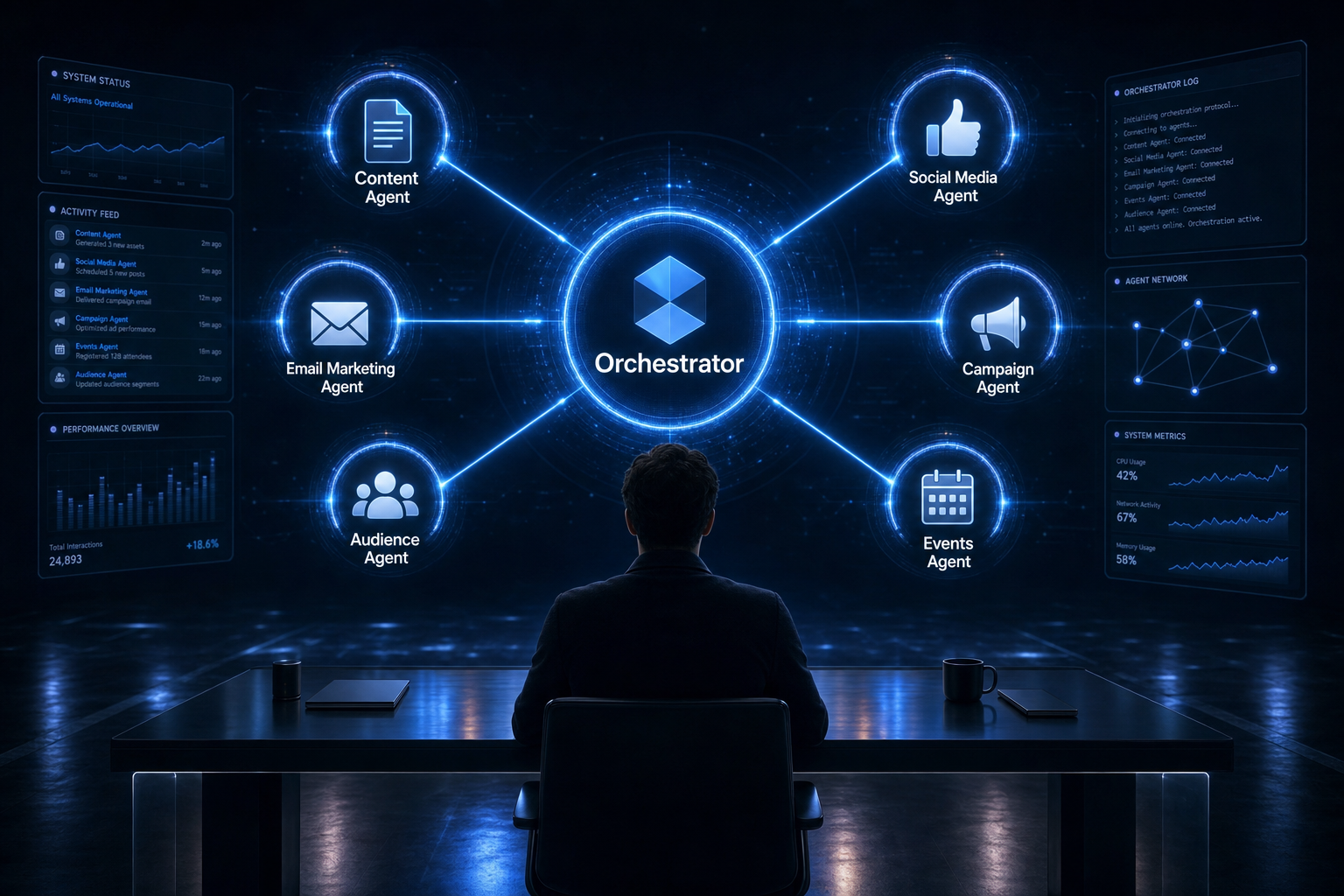
The term "AI marketing agent" is showing up everywhere right now. But most of what gets labeled an agent is really just a chatbot with better branding. You prompt it, it responds, and it stops the moment you stop typing.
More Than a Chatbot: What Makes an Agent Different
A chatbot waits. You open a window, type a prompt, and it generates a response. That's it. The interaction is reactive, contained, and finite. When you close the tab, nothing happens. An AI marketing agent is something fundamentally different.
An agent takes a goal and pursues it. It doesn't wait for you to ask. It plans, executes multi-step tasks, uses tools (search, writing, publishing, analytics), and iterates toward an outcome. The job doesn't end when you stop typing. It ends when the work is done.
Think about the difference in practical terms. A chatbot can write a draft blog post if you ask it to. An AI marketing agent can identify what topic to write about, research it, draft the post, optimize it for search, publish it to your blog, and report back on how it performed. Those are completely different categories of usefulness.
The distinction matters because it changes what's actually possible. Chatbots make you faster at individual tasks. Agents change what your team can accomplish in a day, a week, a quarter. That's the promise of agentic marketing. Not a better keyboard, but a different way of operating.
What Can an AI Marketing Agent Actually Do?
The short answer: more than you'd expect, and more than most tools advertise.
A concrete list of tasks that an AI marketing agent can handle autonomously or near-autonomously:
Content creation. Write blog posts, email copy, social posts, ad copy, landing page text. In your brand's voice, optimized for your audience, with proper SEO structure.
Research. Scan the web for trends, competitor content, supporting statistics, and source material. Surface what's relevant without you having to sift through it.
Campaign planning. Given a goal and a timeline, sketch out a campaign: what to create, when to publish it, who to target, what channels to use.
Email sequences. Draft a full nurture flow: multiple emails, with logic, personalization, and send timing built in.
Publishing. Schedule and post content directly. Blog articles go live, emails get sent, social posts publish on time. No copy-pasting, no tab-switching.
Performance tracking. Monitor open rates, traffic, engagement, and conversions. Flag what's working and what isn't.
Audience management. Segment your list based on behavior, purchase history, or custom properties. Build the right audience for the right message.
Not every AI marketing agent does all of these things, and not every one does them equally well. But this is the category of capability we're talking about. Not a text box you ask questions to, but a system that handles real marketing tasks from start to finish.
The End-to-End Loop: Research, Write, Publish, Track
The real leverage of an AI marketing agent isn't any single capability. It's the ability to connect them. Walk through what that looks like in practice.
Research. The agent starts by scanning the competitive landscape for a given topic. What are people searching for? What's already ranking? What's missing from existing content? This takes minutes, not hours.
Write. With research complete, the agent drafts the content. Not just a first pass. A structured, on-brand draft with proper SEO elements: headline, subheadings, meta description, internal links, a clear CTA.
Publish. The draft goes directly into your publishing system. The agent schedules it for the right time and posts it. No manual export, no copy-paste into a CMS, no separate scheduling tool.
Track. Once live, the agent monitors performance. How much traffic is the post getting? Where is it ranking? What's the engagement? That data feeds back into the next piece of content.
This loop (research, write, publish, track) is the operating model of a competent content marketer. The difference is that an agent can run it faster, more consistently, and across more channels simultaneously than any individual person can. A single marketer with a well-configured AI marketing agent can produce and distribute content at a volume that used to require a team.
Why Humans Stay in the Loop
It's worth being clear about what AI marketing agents don't replace: judgment, strategy, and accountability.
An agent is exceptional at execution. It can run a defined playbook faster and more consistently than any human team. But someone still needs to set the direction: decide what the brand stands for, which audience to prioritize, what campaign to run, what tone to take. That's human work, and it stays human.
An AI marketing agent amplifies what you're already good at. If you're a strong strategic marketer, the agent handles the execution so you can focus on strategy. If you're a founder who understands your customers deeply, the agent turns that understanding into a content operation you couldn't run alone.
What disappears is the drudgery: the hours spent writing first drafts, scheduling posts, setting up sequences, exporting reports. The work that consumes time without adding unique human value.
What to Look for in an AI Marketing Agent
Not all AI marketing agents are created equal. Here's what separates genuinely useful ones from the chatbots wearing agent costumes:
It executes, not just assists. The agent should be able to take an action (publish a post, send an email, schedule content), not just generate text for you to paste somewhere else.
It knows your brand. Good agents maintain persistent memory: your brand voice, ICP, product positioning, competitive differentiators. Content should sound like you, not like a generic AI.
It works across channels. Marketing isn't one thing. The right agent handles your blog, your email, your social, your campaigns, without switching tools or losing context.
It integrates with your publishing stack. If the agent can't actually post to your blog, send from your email platform, or publish to your social accounts, you're still doing the last mile manually.
It tracks results. Execution without feedback is just noise. Look for agents connected to analytics so you know what's working.
It keeps you in control. The best agents are collaborative. They handle the execution but don't go rogue. You can always review, edit, and override.
The Bottom Line
An AI marketing agent is not a smarter search engine or a fancier autocomplete. It's a system that can take a marketing goal and pursue it: researching, writing, publishing, and tracking, with minimal intervention from you.
For small teams and solo marketers, this is the unlock that changes what's possible. Not "I can write faster" but "I can operate a full marketing function at a fraction of the headcount it used to require."
That's not a productivity gain. That's a structural change in how marketing gets done. And it's happening now.
Quotient is built around this model. One platform, a suite of AI marketing agents, everything connected from campaign planning to publishing to analytics. See how it works through our use cases, or start your free trial now.
Blog
Keep up with the latest
from Quotient
Similar Topics