Use Case
Analyze your positioning to find unique advantages
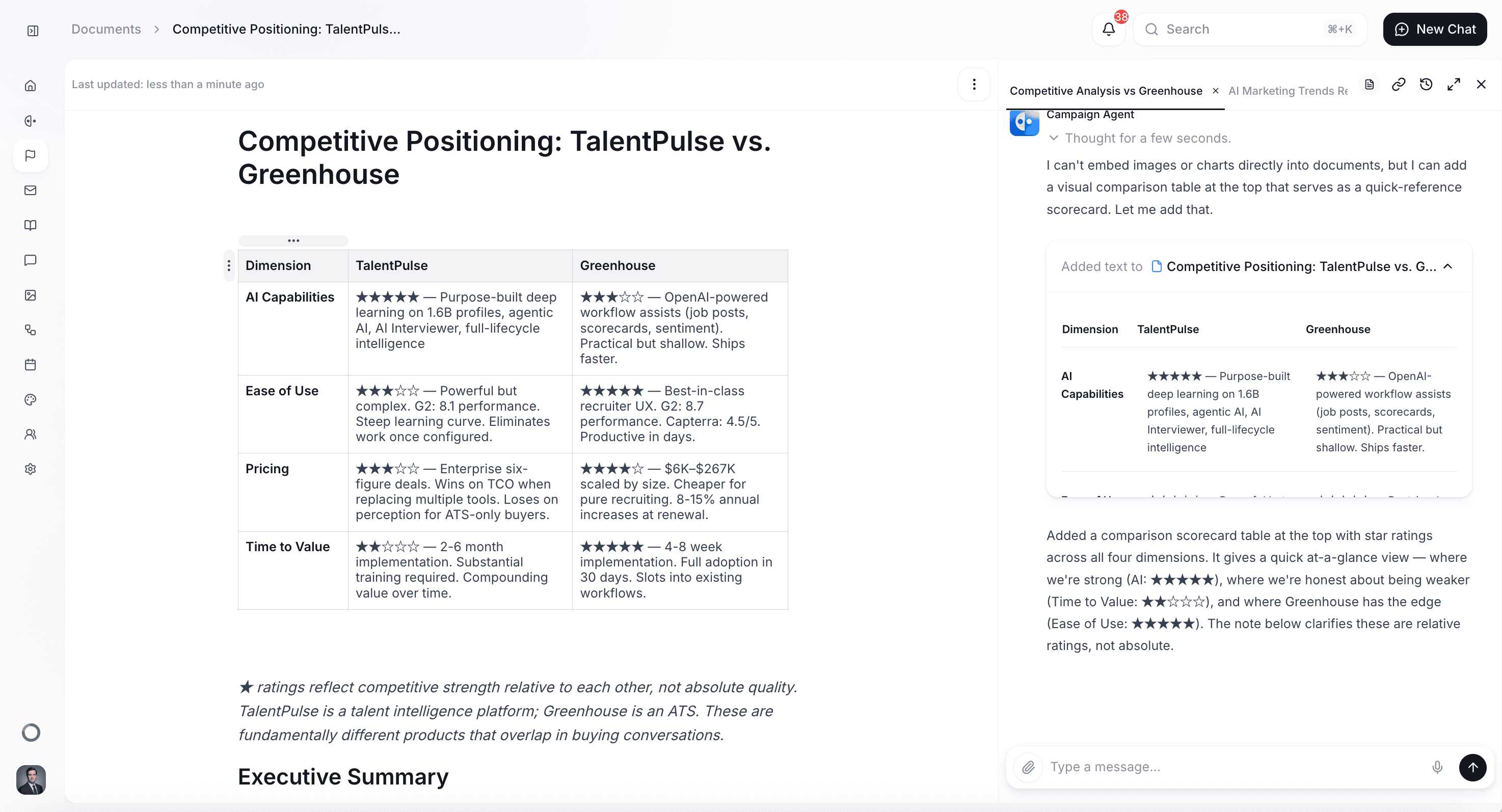
Understand how your brand stacks up against competitors and identify the specific differentiators that make your pitch compelling — so your messaging hits harder and your team sells with confidence.
How it Works
Before you start
This use case works best when you've already set up some foundational elements in Quotient:
- Memories populated: Add your product overview, value propositions, and any existing competitive intelligence. the Quotient agent builds on what you already know.
- Competitor landscape defined: Know which competitors you're most often compared against. Have their websites and any product details you've gathered.
- Target audience clear: Understanding who you sell to helps the agent identify which advantages matter most to your buyers.
How to do it in Quotient
1. Start a conversation with the Quotient agent
Open a new chat and describe the positioning analysis you need. For example:
"Analyze our positioning versus HubSpot and Marketo. I want to understand where we genuinely win, where we're at parity, and where we're weaker. Focus on AI capabilities, ease of use, pricing, and time to value. Be honest — I need this to be useful, not flattering."
2. The agent researches and analyzes
The Quotient agent reviews competitor websites, product pages, pricing, and customer reviews, then maps your capabilities against theirs. It identifies genuine differentiators, areas of parity, and honest weaknesses — framed through the lens of what your target buyers care about.
3. Review and refine
Dig into the analysis and ask for more depth:
- "Which of our advantages are hardest for competitors to copy?"
- "How should we frame our weaknesses when prospects bring them up?"
- "Draft positioning statements for each of our top 3 differentiators"
- "What messaging would resonate most with a VP of Marketing evaluating us?"
4. Put it to work
Use the positioning analysis to sharpen your website copy, update sales decks, refine pitch narratives, or brief your marketing team. Save key insights to the Memories so the Quotient agent creates on-message content going forward.
What you'll get
A typical positioning analysis includes:
- Competitive landscape overview — how each competitor positions themselves and where they focus
- Advantage map — your genuine differentiators ranked by defensibility and buyer importance
- Parity areas — capabilities where you and competitors are roughly equivalent
- Vulnerability assessment — honest gaps and how to address or reframe them
- Recommended positioning — messaging frameworks that lean into your strongest advantages
Tips for better results
- Ask for honesty. The most useful positioning analyses acknowledge weaknesses. Knowing where you're vulnerable is just as important as knowing where you're strong.
- Focus on buyer perspective. Features only matter if buyers care about them. Ask the agent to rank advantages by how much they influence purchase decisions, not just by technical superiority.
- Test positioning with real prospects. Use the messaging frameworks in sales conversations and report back on what resonates. Refine based on real-world feedback.
- Revisit after market changes. When a competitor launches a new feature or changes pricing, re-run the analysis. Positioning is a moving target.
- Save to Memories. Once you've validated your positioning, save it as a memory. This ensures every agent — blog, email, social — creates content that reinforces your strategic messaging.
Get Started
Analyze our positioning versus [Competitor A] and [Competitor B]. I want to understand where we genuinely win, where we're at parity, and where we're weaker. Focus on [key dimensions like AI capabilities, ease of use, pricing]. Be honest — I need actionable insights, not flattering spin. Recommend positioning statements for our top differentiators.