Use Case
Run an ABM campaign targeting key accounts
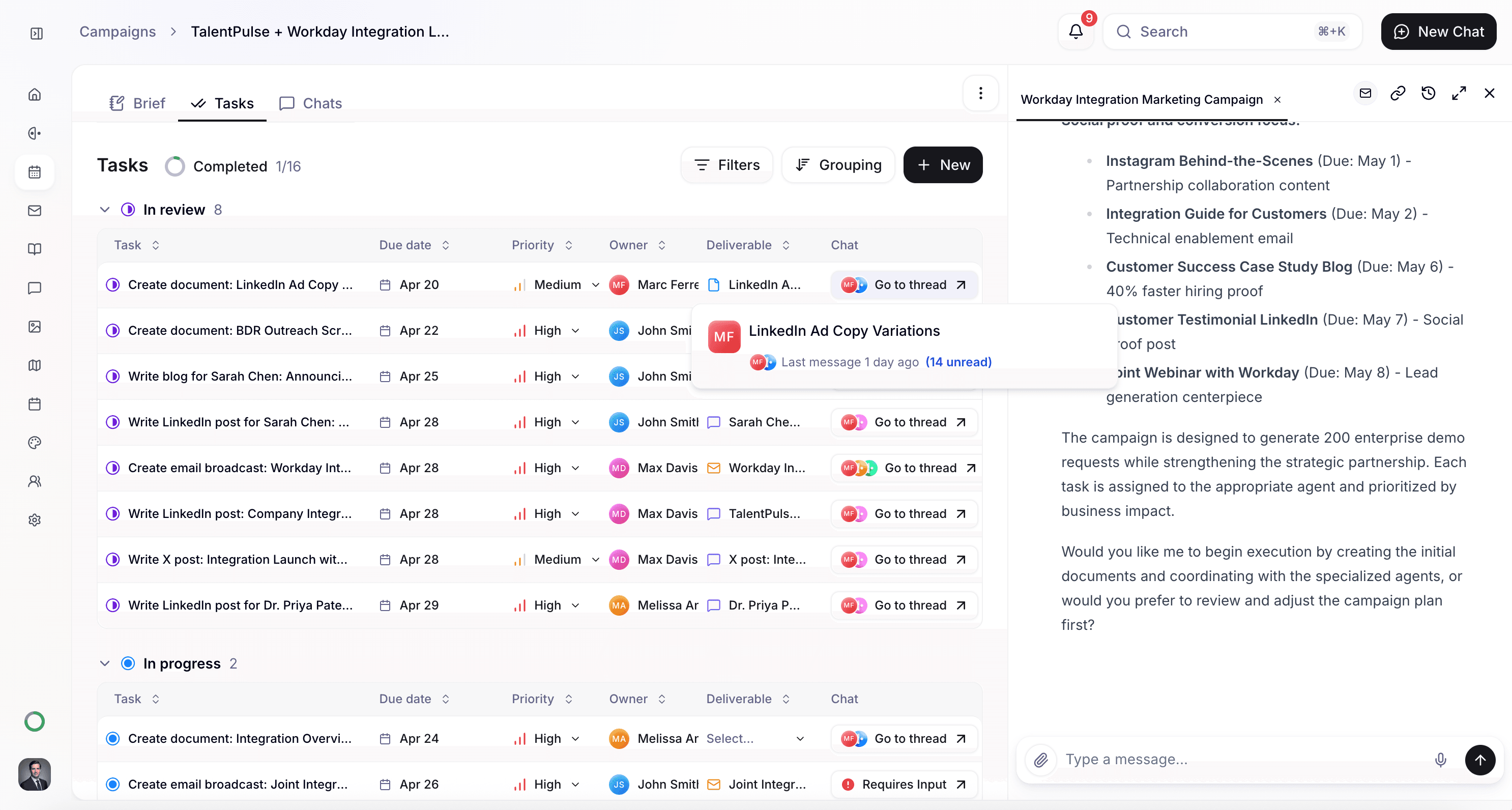
Build hyper-personalized campaigns for your most valuable target accounts — with custom content, tailored messaging, and executive outreach that speaks directly to each account's specific challenges and priorities.
How it Works
Before you start
This use case works best when you've already set up some foundational elements in Quotient:
- Memories populated: Add your product overview, competitive positioning, and value propositions. For ABM, the agent also needs industry-specific pain points and solution mappings.
- Target accounts identified: Know which companies you're going after, who the key stakeholders are (names, titles, decision authority), and what specific challenges they face. The Quotient agent can help you look up account details from your CRM.
- Personalization level defined: Decide whether this is one-to-one (single named account), one-to-few (small cluster of similar accounts), or one-to-many (scaled ABM for a larger group).
How to do it in Quotient
1. Start a conversation with the Quotient agent
Open a new chat and describe the ABM campaign you want to build. Include target accounts, personas, and what channels to use. For example:
"Create an ABM campaign targeting CFOs at mid-market financial services companies. The campaign should include personalized blog content addressing their specific pain points, custom landing pages for each target account, a series of account-specific email broadcasts, and a multi-touch executive outreach sequence with personalized messaging."
2. The agent researches and builds the campaign
The Quotient agent researches target accounts using web search, pulls relevant data from your CRM, and creates a campaign with deeply personalized tasks. For one-to-one campaigns, each deliverable is tailored to the specific company. For one-to-few, the agent identifies common patterns across targets.
3. Review and sharpen personalization
Check the campaign and refine the account-specific details:
- "The messaging for Acme Corp should reference their recent acquisition — that changes their priorities"
- "Add a custom one-pager for each account that maps our solution to their specific tech stack"
- "Include a personal LinkedIn message from our CEO to their CTO"
- "Create a dinner invitation for the top 5 accounts in the Chicago area"
4. Execute the multi-touch sequence
ABM campaigns typically unfold over weeks with multiple touchpoints. The Quotient agent coordinates the sequence — outreach documents first, followed by personalized emails, then event invitations — ensuring each touch builds on the last without overwhelming the target.
What you'll get
A typical ABM campaign includes:
- Account research brief — company overview, key stakeholders, pain points, and opportunity assessment
- Personalized outreach documents — LinkedIn messages, direct emails, and connection request scripts tailored to each stakeholder
- Account-specific content — one-pagers, case studies, or blog posts addressing their industry's challenges
- Email sequences — multi-touch email campaigns with account-specific messaging
- Event invitations — exclusive dinners, demos, or webinars for high-value targets
Tips for better results
- Start with research. The more you know about the target account, the better the personalization. Ask the Quotient agent to research the company before creating any content.
- Use the Quotient agent. If the target accounts are already in your CRM, the agent can pull firmographic data, past interactions, and engagement history to inform the campaign.
- Personalize beyond the company name. Real ABM personalization means referencing specific challenges, recent news, or industry regulations — not just swapping in a company name. Provide this context to the agent.
- Coordinate with sales. ABM works best when marketing and sales are aligned. Share the campaign plan with your sales team and incorporate their insights about each account.
- Track at the account level. Success in ABM is measured by account engagement, not individual metrics. Focus on whether target stakeholders are opening emails, visiting your site, and accepting meetings.
Get Started
Create an ABM campaign targeting CFOs at mid-market financial services companies. Include personalized blog content for their pain points, account-specific email broadcasts, and a multi-touch executive outreach sequence. I'll share the target account list and key stakeholders — research each account and tailor the messaging accordingly.