
Marketing
Introducing the Quotient AI Marketing Playbook

"AI can help with your marketing." I've heard this more times than I can count over the last two years. And every time I hear it, I think the same thing: okay, but help with what, exactly?
The problem isn't that marketers don't believe in AI. Most do — at least in principle. The issue is that "AI can help with marketing" is about as actionable as "exercise is good for you." Everyone nods. Nobody has a plan.
Over the past year I've talked with hundreds of marketers at companies of all sizes. Same story every time: they'd tried AI tools, seen flashes of potential, maybe used ChatGPT to brainstorm ideas or draft a few emails. But actually changing how they run marketing day-to-day? Still stuck.
The Gap Between Knowing and Doing
When we started building Quotient, one of the first things we noticed was how lost people get when they first sit down with an AI agent. They don't know how to speak to it. They don't know what it can do or not do. They're faced with a message box and nothing else — maybe a couple of suggestions at the bottom — and that's it.
A great marketer with a powerful tool and no playbook is like a great chef with a stocked kitchen and no recipes. The potential is real. The output isn't happening.
That's what we set out to fix.
The Quotient AI Marketing Playbook
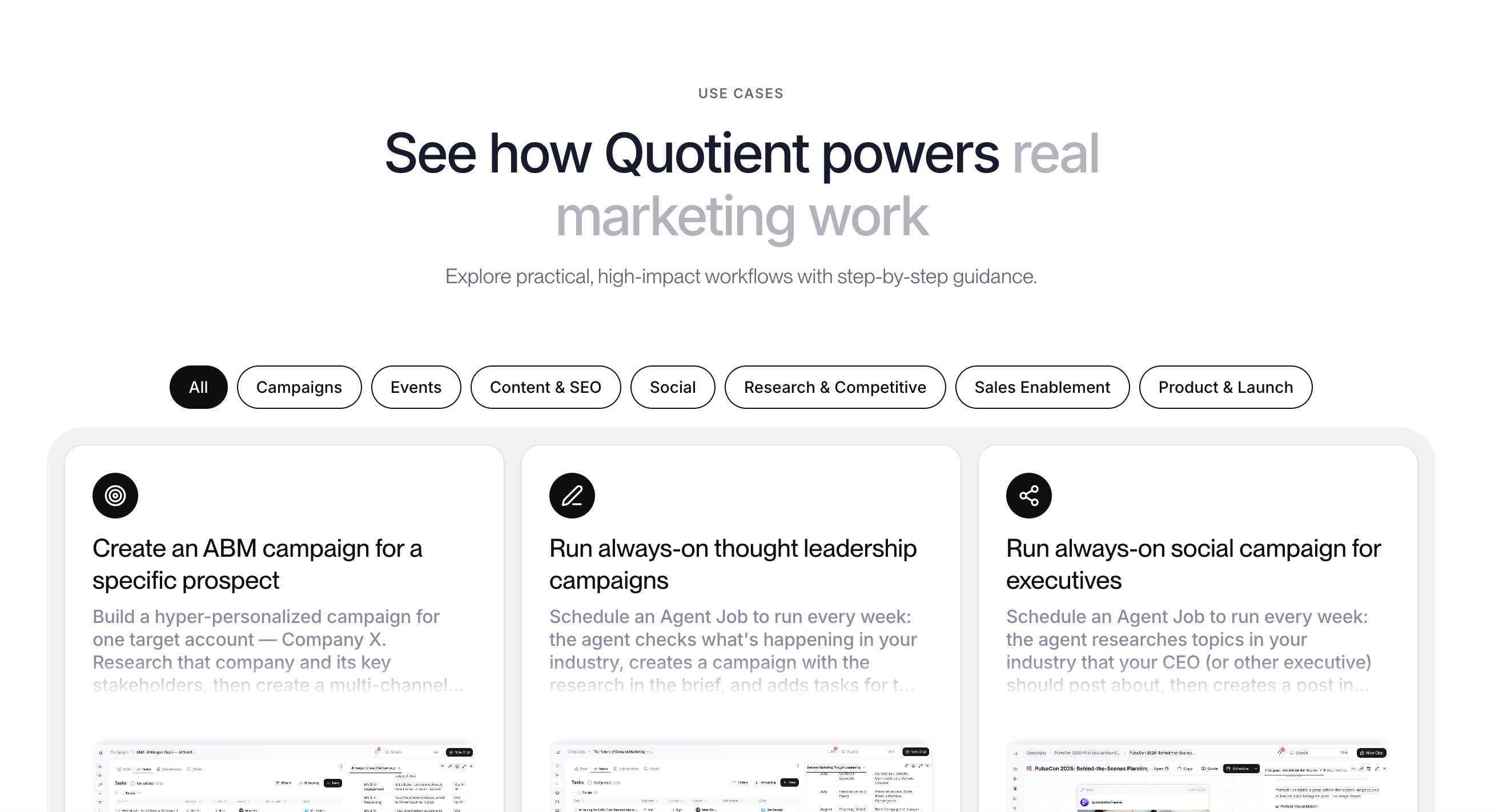
Today we're launching the Quotient AI Marketing Playbook — a library of 39 real-world marketing use cases, each with step-by-step guidance, the prompts to get started, and examples of what you'll get. The full library lives at getquotient.ai/use-cases.
These aren't things AI could theoretically do in some idealized scenario. These are plays you can run today. They're organized across seven categories:
Campaigns — ABM for specific prospects, thought leadership series, product launches, campaign variants by segment
Events — Webinars, trade shows, VIP dinners, roadshows, executive roundtables
Content & SEO — Blog optimization, keyword research, competitor content audits, SEO automation with Agent Jobs
Social — Executive ghostwriting, thread creation, trending topic engagement
Research & Competitive Intelligence — Battle cards, competitor monitoring, positioning analysis
Sales Enablement — One-pagers, demo scripts, objection handling
Product & Launch — Feature adoption campaigns, integration announcements, partner launches
Each use case walks you through the actual workflow: what to tell the agent, what context to provide, what the output looks like. The goal was to make the "but how do I actually do this?" question go away entirely.
Three Plays Worth Your Attention
Rather than walking through all 39, I want to spotlight three that show what makes Quotient different from a generic AI writing tool.
Create an ABM Campaign for a Specific Prospect
You give Quotient a target company, and the agents do the work: research the account, identify key stakeholders, understand their pain points, then build a tailored multi-channel campaign — email, content, social — personalized for that specific company.
Hyper-targeted ABM like this used to take a team of people several weeks. Now it takes minutes. And because Quotient pulls in your brand positioning, your Knowledge Store, and your competitive context, the output reflects how you actually sell — not generic AI copy that could have come from anywhere.
Run Always-On Thought Leadership with Agent Jobs
One of Quotient's most powerful capabilities is the ability to run marketing autonomously, on a schedule. Agent Jobs lets you set a recurring prompt for any agent. Once a week, the agent researches what's happening in your industry, creates a campaign brief, and stages the deliverables — blog post, email, social posts — ready for your review.
You wake up Monday morning and your thought leadership for the week is already in motion. No hunting for ideas. No staring at a blank calendar. The agent keeps your content engine running without you actively managing it.
Build Competitive Battle Cards for Your Sales Team
This one extends beyond marketing into sales enablement. You point Quotient at a competitor, and it researches their positioning, product capabilities, pricing signals, and customer feedback. The output is a detailed battle card: side-by-side comparisons, objection handling, win/loss positioning.
Your sales team gets a resource they can pull up before any competitive deal. And with Agent Jobs, you can set it to refresh automatically as competitors evolve — so your reps are always working with current intelligence, not a PDF someone built six months ago.
Quotient Can
The tagline we landed on for this launch is simple: Quotient Can.
It's deliberately blunt. The whole point of the Playbook is to replace vague promises with specific plays. Quotient can build a personalized ABM campaign for your top prospect. Quotient can ghostwrite your CEO's LinkedIn and X on a recurring schedule. Quotient can monitor your competitors every week and update your Knowledge Store automatically. Quotient can arm your sales team with fresh battle cards before every competitive deal.
The Playbook is how we're making that concrete — one use case at a time.
Two questions I hear constantly from marketers evaluating Quotient: "Where do I start?" and "What should I try next?" Those are exactly the questions the Playbook is built to answer.
Explore all 39 use cases at getquotient.ai/use-cases. Each one includes the full workflow and the prompts to get started. If you're already using Quotient, pick one and run it this week. If you're evaluating us, the Playbook is the fastest way to see what's possible.
Quotient can. Now let's see what you can do.
Blog