


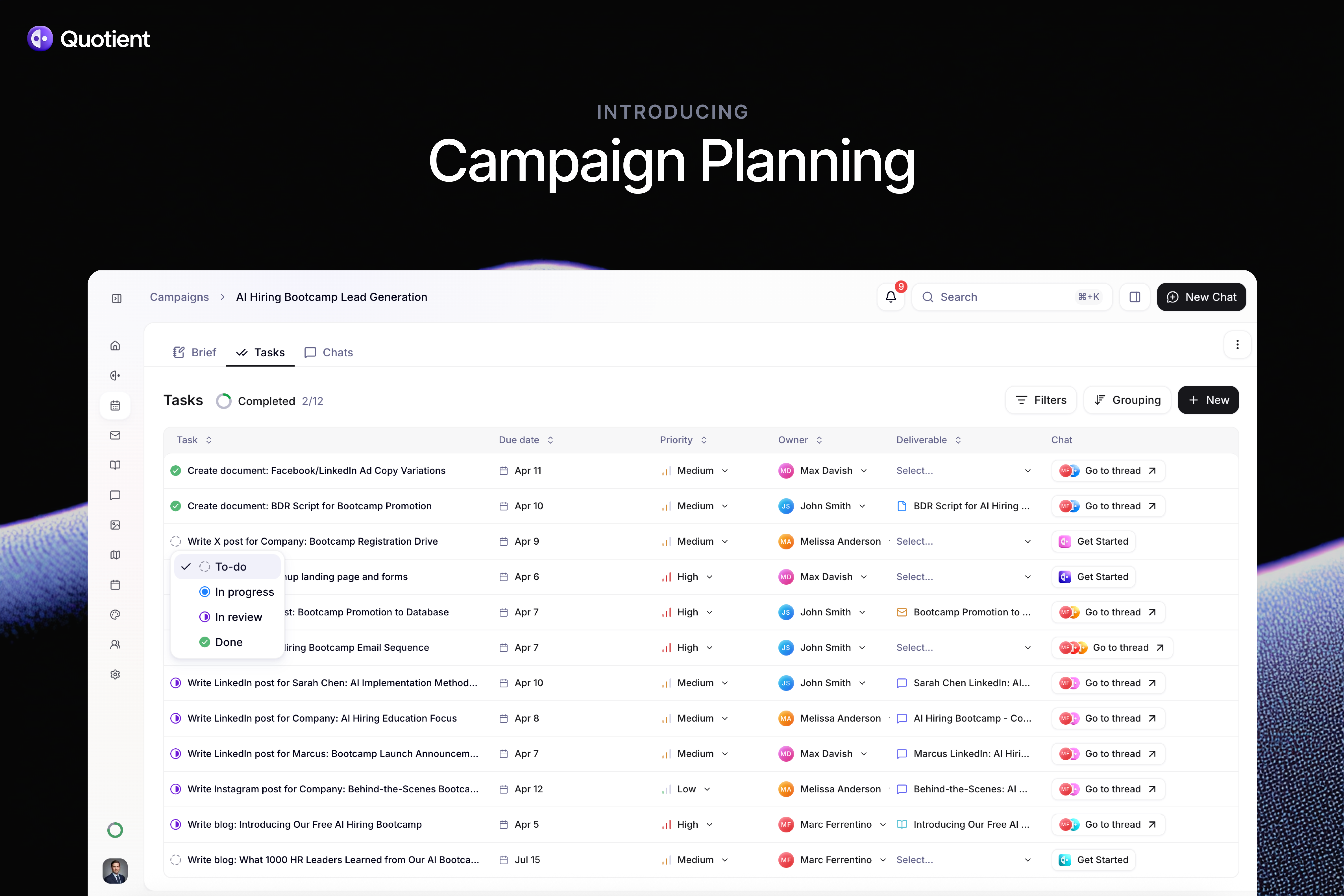
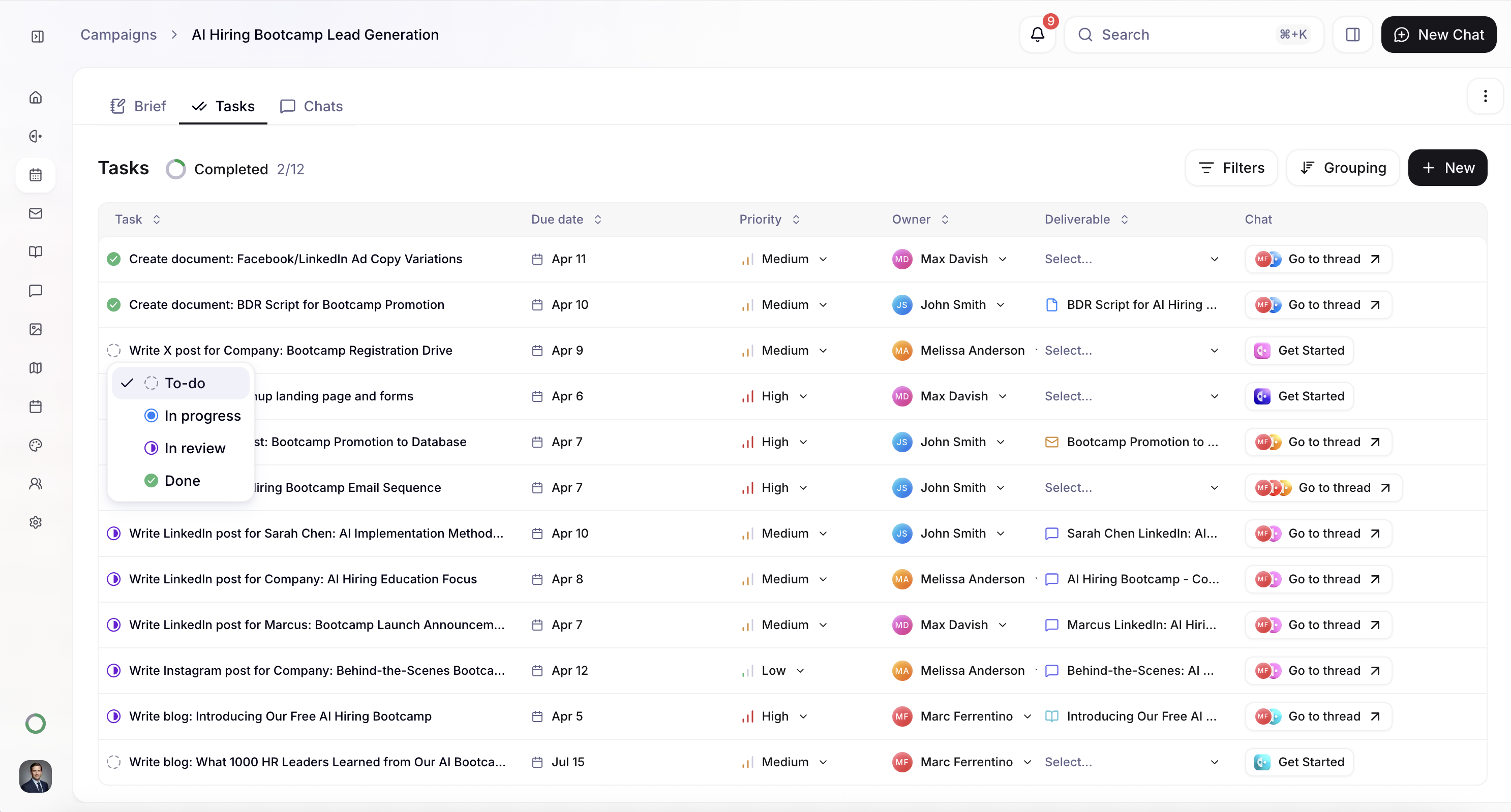
I'm going to start with something meta: this blog post was created using Campaign Planning—the feature I'm announcing. The Campaign Agent created a task called "Write blog for Max: Introducing Campaign Planning," delegated it to the Blog Agent, and when the blog was done, it automatically linked back to the task. All 11 tasks in this launch campaign were planned and tracked using the system I'm about to walk you through.
Campaign Planning organizes marketing work around three concepts: Campaigns, Tasks, and Deliverables.
How It Works
Campaigns group related marketing work around an objective. Each campaign has a brief explaining the strategy, audience, and messaging. When agents create content for a campaign, they read this brief for context.
Tasks are discrete work items. "Write Max's product blog." "Create LinkedIn announcement." "Generate blog image." Each task has an assignee (human or AI agent), due date, and priority.
Deliverables are the actual marketing assets—blogs, emails, social posts, events. When an agent creates a deliverable, it automatically links to its task.
[Screenshot of Campaign Planning interface]
Human-AI Coordination
When the Campaign Agent plans a launch, it creates tasks for both humans and agents. Some tasks are pure agent work ("Generate blog imagery"), some are pure human work ("Record demo video"), and many involve both ("Write blog" means the agent drafts, human reviews).
Agents and humans share the same view. When the Blog Agent starts writing, it reads the campaign brief. When you edit that blog, the changes appear in the linked deliverable. Everyone sees the same tasks, deadlines, and work in progress.
What makes this different from generic project management tools is that Quotient is both where you plan the campaign and where you execute it. When the Campaign Agent creates a task for the Blog Agent, that same Blog Agent can immediately start writing in the same platform. The campaign brief the Campaign Agent wrote becomes the context the Blog Agent reads. Nothing gets lost in translation between planning and execution because the same AI agents handle both.
Why We Built This
When Marc and I started Quotient, we wanted humans and AI agents to genuinely collaborate—not just AI features bolted onto traditional software, but a system designed for teamwork from the beginning.
We had agents that could write blogs, create emails, and generate images. But we kept hitting the same problem: how do you coordinate multiple agents and humans working on interconnected deliverables for the same campaign? Generic project management tools don't understand marketing workflows or how to represent AI agents as team members with responsibilities.
Campaign Planning makes campaigns, tasks, and deliverables first-class concepts in the platform. When you ask the Campaign Agent to plan a launch, it creates a structured plan with task assignments. When agents complete work, deliverables automatically connect to tasks. This is the infrastructure that makes human-AI collaboration work at scale.
Try It
Campaign Planning is available now for all Quotient users. If you're new to Quotient, sign up for our beta.
Ask the Campaign Agent to help you plan your next launch. Watch how it creates task lists, assigns work to agents, and keeps everything coordinated as your campaign comes together.
Blog
Keep up with the latest
from Quotient
Similar Topics